ProductsGlyph Pharmacy·the antibiotic enforcement loop
A prescription that can prove itself
A drug shop in a Lakshmipur bazaar, run by a man everyone calls doctor though he holds no degree. A mother comes in: her child has had fever and a cough for two days. He reaches for an azithromycin course, because that is what moves and what keeps her from walking to the shop forty meters down the road. There is no prescription. There will be no follow-up. This counter is where Bangladesh's antibiotics are actually rationed, by sales instinct, not clinical judgment.
Pharmacies · Dispensers · Drug regulators
Glyph Pharmacy · the antibiotic enforcement loop
01
The most documented failure in Bangladeshi healthcare
The studies do not merely agree. They escalate. A WHO-linked classification study found 50.9% of antibiotic courses purchased without a registered physician's prescription. A 2024 observational study across 246 Dhaka pharmacies found only 36.2% of antibiotics sold against a registered prescription. A survey of 287 pharmacy staff across four regions found 92.4% reporting that they dispense antibiotics without prescriptions.
The dispenser is usually not a pharmacist. Bangladesh has roughly 107,000 licensed retail pharmacies and an estimated equal number of unlicensed ones, and in one Dhaka study only 7.6% of pharmacies had a registered pharmacist present. When asked why they dispense without prescriptions, the answers are economic, not malicious: fear of losing the customer was cited by 99.5% of rural dispensers. The law against over-the-counter antibiotic sale exists. Enforcement does not.
The consequence is antimicrobial resistance: first-line antibiotics losing efficacy, rising treatment costs, higher mortality from bacterial infection, in a country that combines the loosest access with one of the highest infectious-disease burdens.
The prescription is not a control. Pharmacy makes it one.
02
The Swedish loop, built for Bangladesh
Sweden, Denmark, and the UK brought antibiotic dispensing under control the same way: the prescription is a system record, not a piece of paper. Glyph Pharmacy is that loop, adapted to a counter staffed by a non-pharmacist on a basic Android phone.
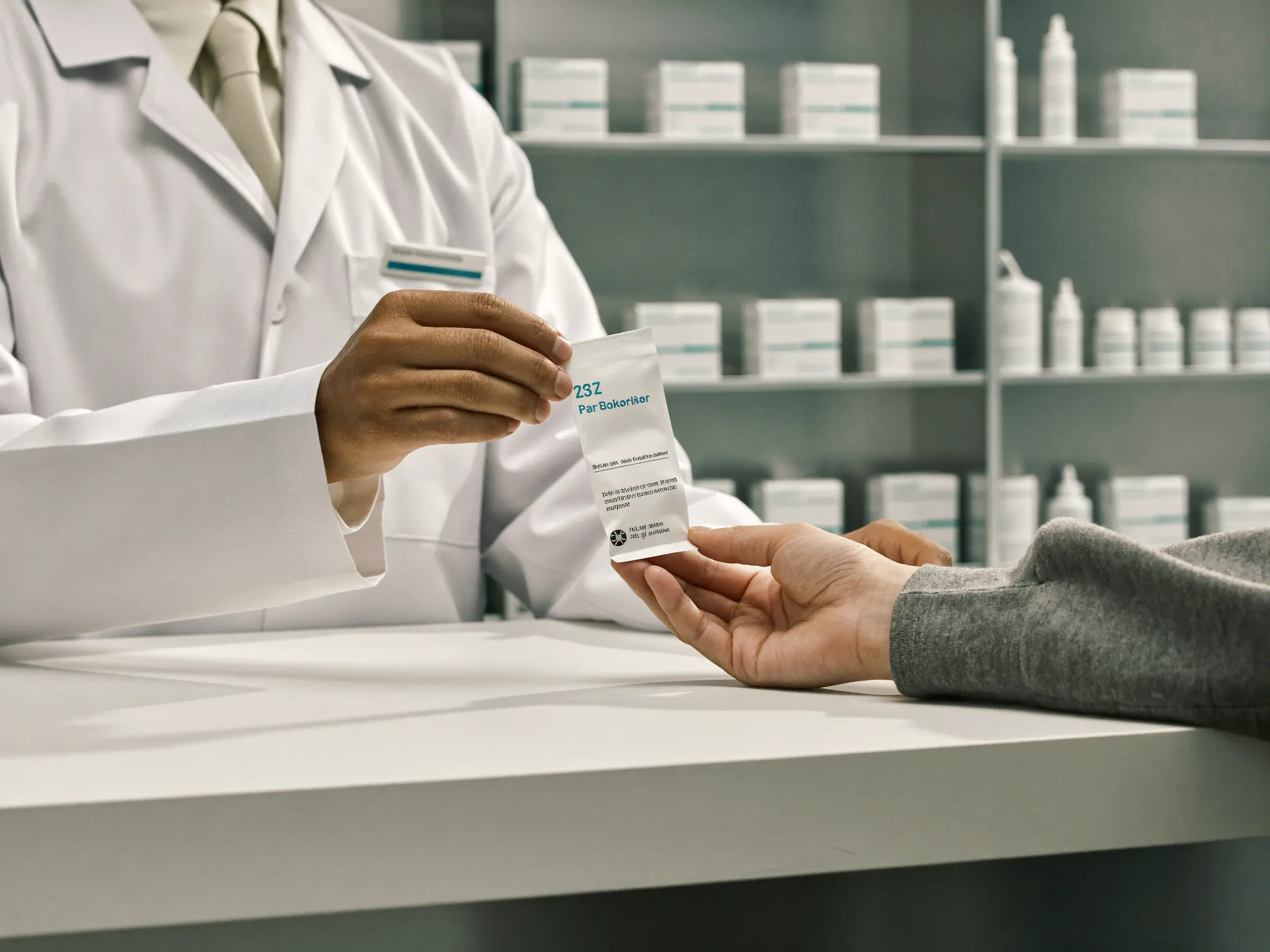
The dispenser queries the patient's identity, with consent, by QR or phone number. The wallet returns the active prescription, signed by the prescribing physician's BMDC-anchored identity. The screen shows what was prescribed, by whom, when, and for how long. Nothing is hand-read, so the 46% illegibility problem disappears at the counter. For controlled categories, antibiotics first, a valid signed credential is the condition of dispensing. The forged prescription, the expired course, the antibiotic bought on a hunch: each fails at the verification step rather than at the conscience of a salesperson who fears losing the sale.
Dispensing events are written back as signed credentials, so adherence becomes visible: the course abandoned on day three surfaces in the prescriber's follow-up. And KhaM-Med assists the dispenser in plain Bangla: what the prescription means, what to counsel, when to refuse and refer.
03
Free, because the public good is the point
Pharmacy is free to participating pharmacies. The enforcement layer cannot be a revenue line; its value is the antibiotic loop closing across a community, and that only happens at density. The pilot strategy follows: saturate one administrative unit with Chamber prescriptions first, roll Pharmacy out free in the same unit, then measure non-prescribed antibiotic dispensing against the documented 50 to 92% baselines for six months and publish the results to WHO Bangladesh, the DGDA, and the press. With evidence in hand, the path to a DGDA-recognized credential-based dispensing standard opens. The state has publicly failed to bend this curve. Publishing the data that bends it is how the network earns formalization.
04
Where it stands
The prescription-signing side runs in production today through Chamber, and the pharmacy verification loop has been demonstrated end to end, including revocation reaching the counter. Full Pharmacy deployment is correctly sequenced behind Chamber density, as a Year 2 to 3 product. It is the payoff of the network, not its entry point.